




The dAIEDGE consortium’s participation in DATE 2026 provided an excellent opportunity to showcase key advancements in the field of edge AI, particularly at a time when efficiency, scalability, and reliability have become critical factors for the adoption of AI solutions in real-world environments.
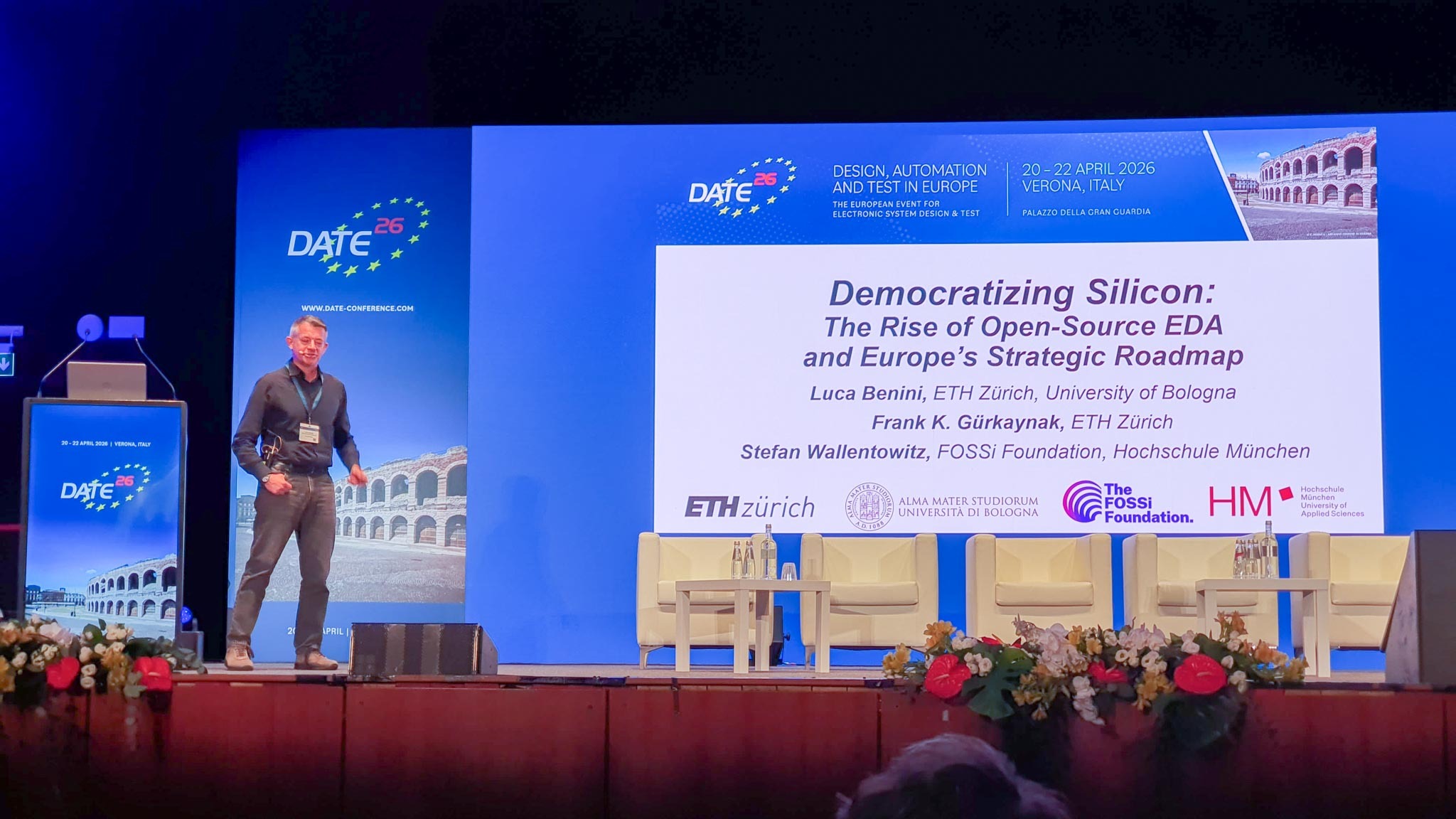
During the event, dAIEDGE presented three contributions that, together, reflect the project’s comprehensive approach: from innovation in hardware and algorithms to building a robust European ecosystem around distributed AI.
One of the standout presentations was TrainDeeploy, presented by Luca Benini on behalf of the ETH Zurich team. This proposal addresses one of the biggest challenges in edge AI: efficient on-device training. TrainDeeploy introduces a complete pipeline that enables not only inference but also model fine-tuning, including Transformers, on ultra-constrained systems. The use of techniques such as LoRA demonstrates significant reductions in memory and trainable parameters, paving the way for truly autonomous and adaptive devices.
At the same time, the presentation on NX-CGRA, led by Rohit Prasad from CEA, highlighted the need for flexible hardware architectures to support the growing diversity of Transformer-based workloads. Their proposal for a programmable accelerator based on CGRA offers a particularly compelling balance between energy efficiency and adaptability, moving away from rigid solutions and toward architectures capable of evolving alongside the models. This approach is particularly relevant in edge scenarios where power and area constraints are critical.
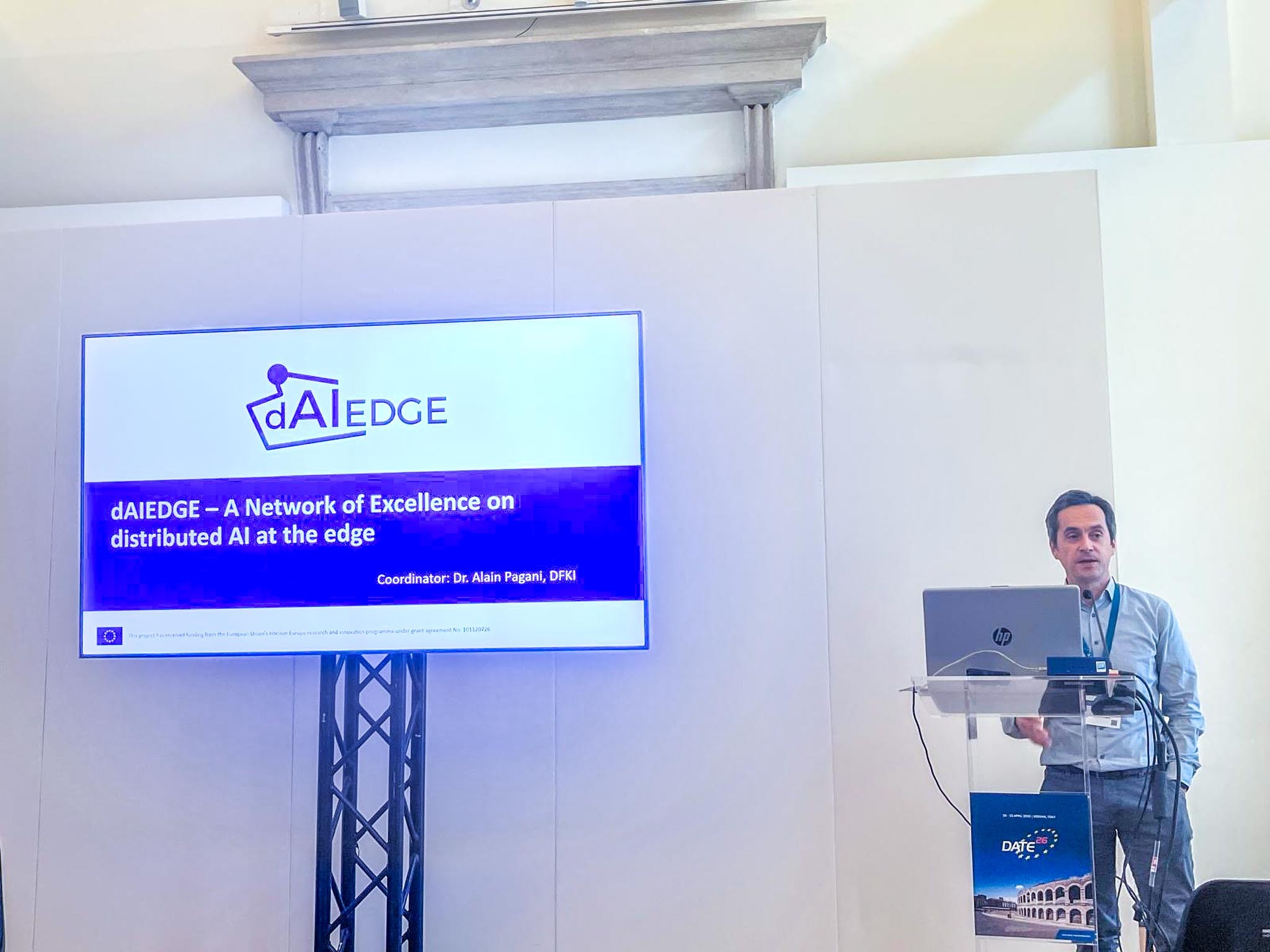 Although our participation did not end there, the centerpiece of dAIEDGE’s participation was the presentation of the project itself, led by Alain Pagani, Project Manager of the initiative, from DFKI. This presentation allowed for contextualizing the technical developments within a broader strategic vision: the creation of a European network of excellence that drives distributed, reliable, efficient, and scalable AI. Beyond specific advancements, the presentation highlighted dAIEDGE’s role as a catalyst for collaboration between academia, industry, and public bodies, aligned with the goals of European technological sovereignty. His presentation focused on how to integrate these lines of research, specialized hardware, efficient training, and adaptive architectures, and how they converge into a common roadmap. It is not just about optimizing models or devices, but about building a cohesive ecosystem capable of sustaining European leadership in the data economy.
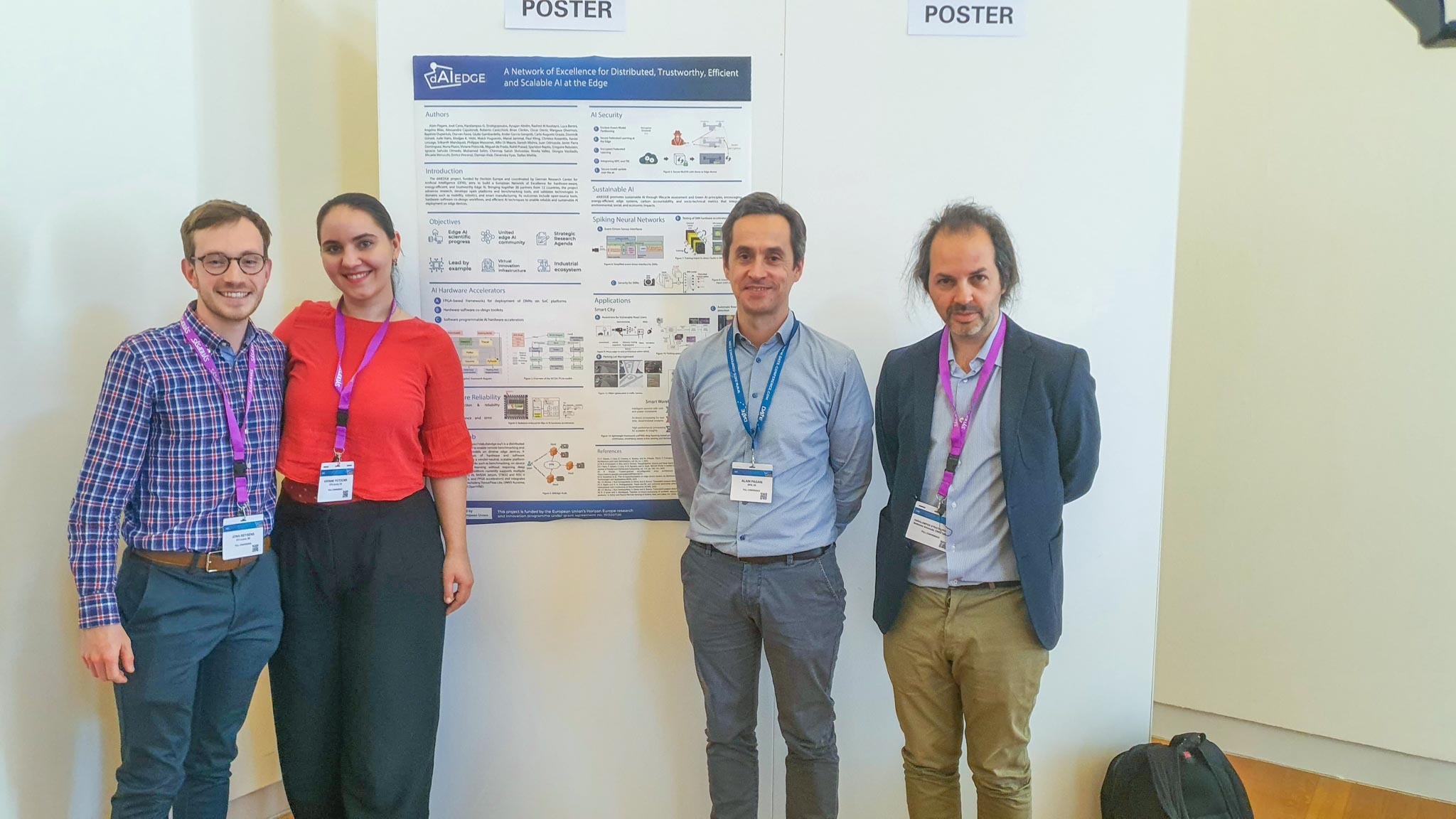
Furthermore, during our participation at DATE 2026, attendees had the opportunity to view our paper presented in poster format, which allowed for direct conversations with the community and a deeper exploration of dAIEDGE’s objectives, technical approach, and mission. This close interaction proved particularly valuable for conveying not only the results but also the project’s vision and its expected impact on the European Edge AI ecosystem.